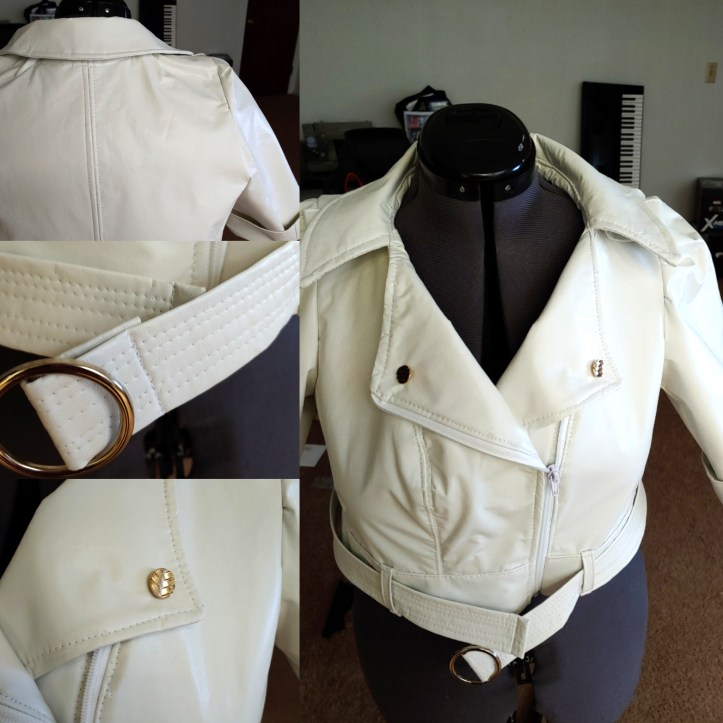
It’s no secret that I love a good vinyl tablecloth. I use this material for everything from belts to shoe covers and even full complete jackets. It’s a relatively versatile material that’s good for a cheap alternative to leather. You can find it as a tablecloth or as rolls of fabric at the fabric store.
Skill level: intermediate
Cost: relatively budget-friendly.
Buying the fabric by the yard is on average $10 before coupons and is about 60″ wide. You can also look at thrift stores for a budget-friendly option
Common supplies for working with this fabric:
- Sewing machine. It does not need to be heavy duty as even budget machines can sew this with the right needle
- Leather needle
- Walking foot, teflon foot, or nonstick foot (we’ll talk more about that in a bit)
- Sewing clips or very sharp stick pins
- Fabric scissors, a sharp rotary cutter, the usual fabric cutter types
So let’s talk about tablecloths!
Fabric rundown
Let’s talk fabric stats
- Fabric type: synthetic
- Fabric weight: medium
- Material content: plastic with felt or flannel backing
- Opacity: opaque
- Stretch type: none
- Grainline: negligible
- Drape and flow: not good
- Strength: strong and durable
- Does it fray: nope
- Original use: tablecloths and furniture upholstery
- Other notes: waterproof on the vinyl side
Tablecloth vinyl is a type of PEVA fabric (common in things like shower curtains and tablecloths) with a colored plasticky material on the right side of the fabric and white felt or flannel on the wrong side. Tablecloth vinyl comes in a variety of colors, sometimes even in patterns. If you buy it on the roll, it tends to come in more stock colors like blacks, browns, and whites.

Tablecloth vinyl tends to err on the heavier side of a medium-weight fabric. It’s a bit stiffer than cotton and feels closer to canvas. This fabric wouldn’t be good for pants (unless you never want to move in them ever) but it works better for things like coats, boots, shoes, bracers, and belts. Being a synthetic fabric, it does not breathe at all, so avoid large garments like coats and jackets in the summer. If you have the proper breathable gear underneath, it can work great for a leather-like fabric for cheap.

Because of this stiffness and heavier-medium weight to the fabric, larger projects can feel pretty weighty. A floor-length coat can weigh quite a bit, especially when it has multiple layers to it. However, you can use that stiffness to your advantage. Larger projects such as a coat can hold its shape relatively easily, which works great for stiffer video game models or non-flowing coats in anime. Just make sure to hang up the finished cosplay on a heavy-duty hanger. I broke several hangers trying to hang up this coat.
Storage
That brings us to the challenge of storage. Tablecloth vinyl, like most vinyls, creases horribly. And like most vinyls, creases do not like to come out of the fabric. The finished piece needs to be stored on a hanger or a dress form and kept away from things that could rub against it. While vinyl stains can generally be wiped away, white vinyl especially likes to pick up other colors and not let them go. My white jacket was ruined when rubbing up against a black jacket in a hot closet during the summer. Using a garment bag can help with this issue.
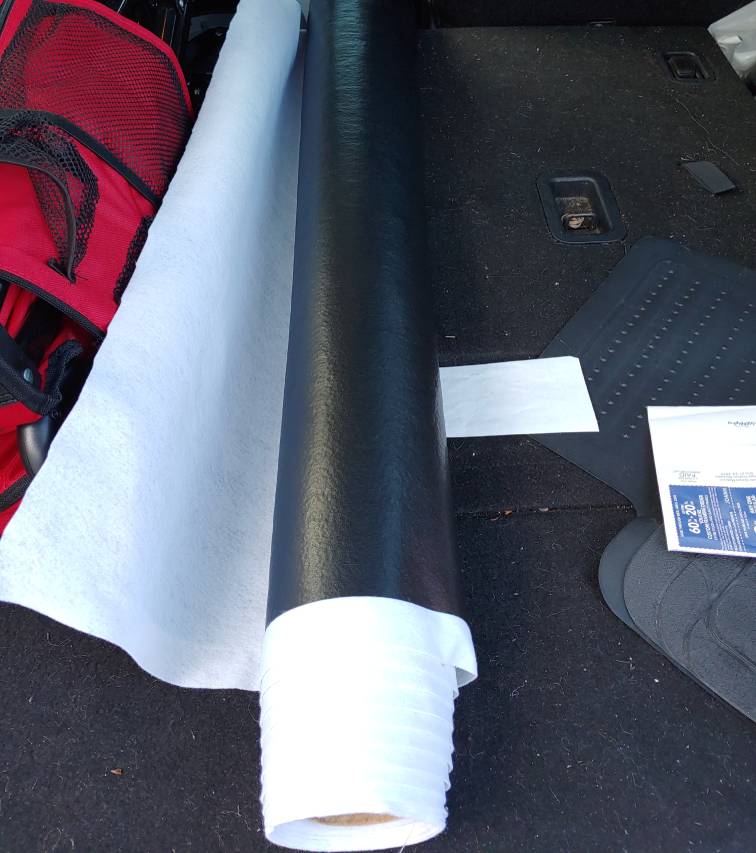
When storing the fabric, it’s best to store it rolled up. You can roll it up around itself and store it on a shelf or under the bed, but if you have a large amount of vinyl to store, roll it up on a cardboard tube, a PVC pipe, or something else long and round. Avoid folding the fabric if possible. Even store-bought tablecloths, it is recommended to roll them to store them for future fabric use (if you’re putting it on your table, you can store it how you like). This prevents creasing and warping in the fabric that’s difficult to get out.
Sewing
This is cosplay, after all, so let’s talk about sewing with tablecloth vinyl.
- Machine needle: heavy duty or leather needle
- Machine foot: walking, teflon, or non-stick foot
- Foot pressure: low
- Thread type: polyester
- Hand sewing: standard sharp with a thimble
- Edge finishes: can be left raw
Fortunately as tablecloth vinyl is a medium-weight fabric, you do not need a heavy-duty machine to work with it. Even budget machines can sew just fine. The trick is the foot you use. Because of the vinyl coating, this fabric feels sticky under a standard foot and doesn’t like to move in the machine. There are a few different feet you can use but my favorite is the walking foot.
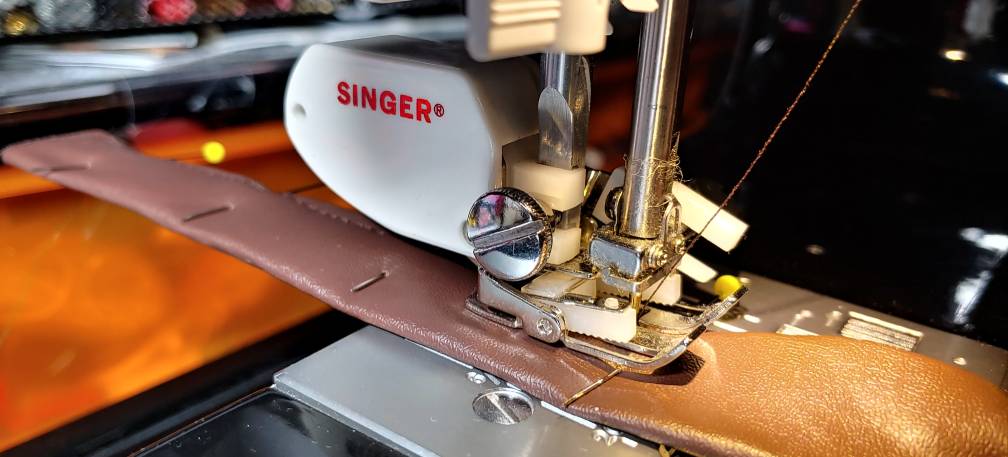
The beauty of the walking foot is that it has feeder dogs on the foot. These feeder dogs move by following the motion of the needle using an arm that attaches to the needle screw. So the foot literally walks across the fabric, giving it a nice even feed on both the top and the bottom of the fabric. You can find a walking foot at most fabric stores, and a standard foot can fit most modern machines. If you have an industrial or older machine, check to see what works with yours.
And you’ll need that foot that doesn’t stick to the vinyl. Since ironing vinyl doesn’t work well, you need to topstitch your seams to make them lay flat. If you don’t, your seams will start to fold in on themselves and the garment may not look right when worn. Topstitching prevents that and makes your seams look more like leather stitchwork, but it also means that you need to be sure that your seams are where you want them to be. Ripping out threads will leave needle holes on your fabric if you need to move a seam.
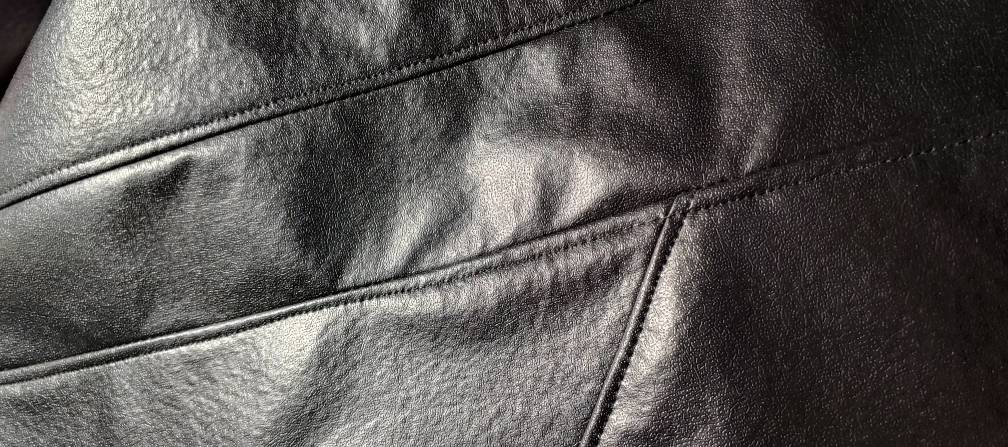
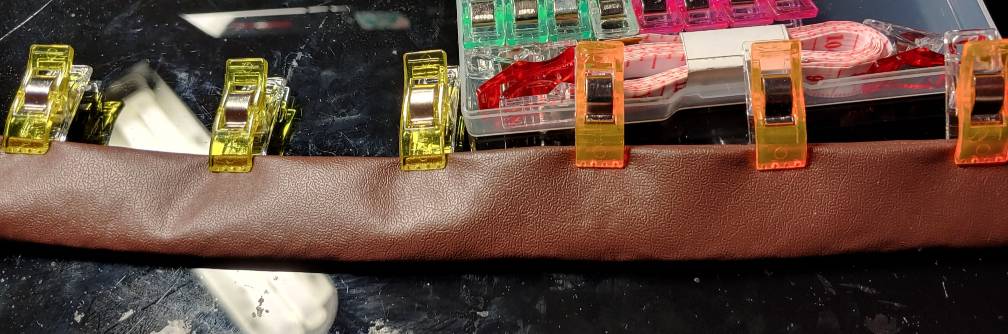
Speaking of holes, the second source of holes are pins. You can idealy use fabric clips for your pinning needs to reduce the number of holes you put into your vinyl.
But sometimes you cannot avoid the need for pins. This is often in places like pinning the fabric down for topstitching, some detailing, and even if you don’t like using clips like me. In this case, I recommend having very sharp pins as duller pins cannot get through the fabric thickness. The smaller pins will give you the smallest holes that you can really just rub out with your finger and cover up. Larger quilting pins may be needed for thicker seams or larger areas where small pins just cannot get the fabric to stay put. Make sure the pins are as sharp as possible to reduce the impact of the pin on the fabric.
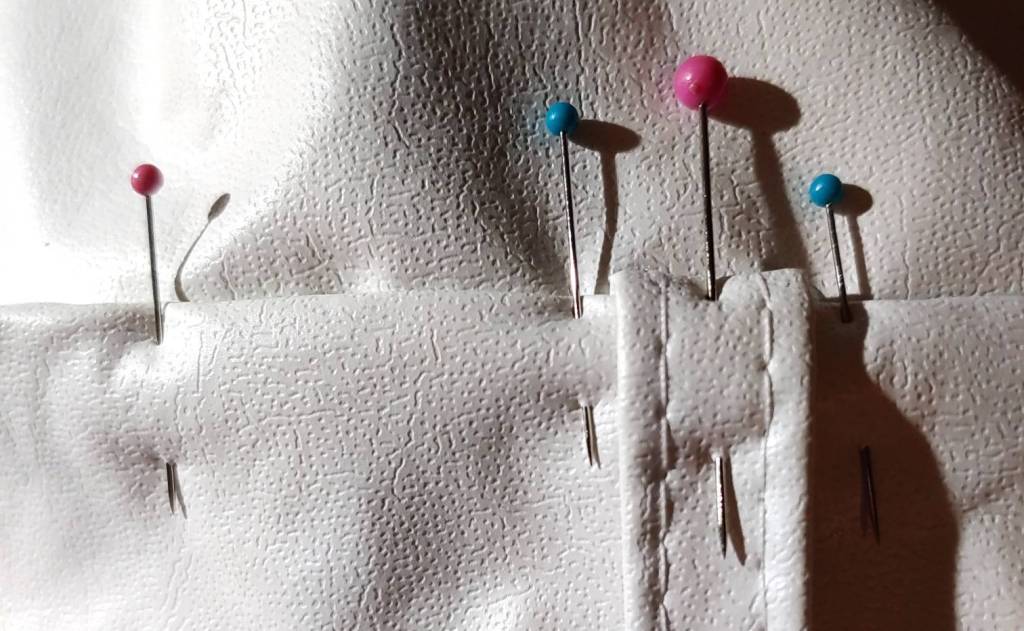
For finishing your edges, you can leave them raw if you like. You will see the flannel or felt backing on the edges if your vinyl isn’t white, but that doesn’t matter if it’s an inner seam. If it’s an outer seam or edge, you can simply fold the edge over and sew it down with a straight stitch. You do not need to pink or serge an edge as vinyl does not fray.
Patterning
Being a medium-weight fabric, you can generally use tablecloth vinyl for patterns with middle-weight requirements. Jackets and coats are likely a good place to start with commercial patterning. You can also choose to make your own by modifying patterns or creating patterns on a dress form or yourself. Tablecloth vinyl has very little drape, so keep that in mind when creating patterns.
Let’s talk about some pattern basics
- Scissors: regular fabric scissors
- Rotary cutter: regular rotary cutter for medium-weight fabrics.
- Can trace the pattern on the white fuzzy side of the fabric
- Can pin in the seam allowance of fabric or use fabric weights

For the most part, cutting tablecloth vinyl is like almost any other medium-weight fabric.
The biggest difference is that you cannot get flat folds like cotton or polyester could. Instead the edge kind of rolls over and puffs out. If you do not need to cut something on the fold, you can simply cut the fold for the fabric to lay flat on your table.
If you do need to cut on the fold, press the fold down a bit to make sure you have the pattern piece in the right location before tracing the pattern on the back of the fabric.
You can also trace your pattern pieces and mark them to your heart’s content with a pen. As the fabric is opaque, you don’t need to worry about it being visible on the other side. Stick with a pen as a marker can still potentially damage the fabric.
Heat
Heat and plastic don’t always mix, and vinyl honestly is no different. But can you use heat?
- Ironing: lowest setting and only on the back using a press cloth
- Fusible interfacing: probably not. Use sew-in instead
- HTV: surprisingly yes. Heat press is recommended for control. Use a cover sheet.
You can technically iron a tablecloth. It’s how you get the folds out of the premade tablecloths when you pull them out of the package. You can iron the tablecloth on the lowest setting and only from the back, but to be honest? It does very little to help with the wrinkles. It’s best to avoid wrinkles by rolling the material in the first place.

What surprised me is that tablecloth vinyl can actually handle HTV and the heat required to set it. HTV can be pressed into leather, and the leather temperature and press method transfer really well to vinyl. For one project, I pressed Brick HTV into the back of lapels to create an embossed design. You can also press other kinds of HTV into vinyl as well.
When pressing HTV onto vinyl, you will need a cover sheet to prevent burning your fabric. Parchment paper works great for this. You can get it in the kitchen aisle at the store.
Painting and decorating
As tablecloth vinyl is a waterproof fabric, painting and dyeing actually do not work well. The surface is just too slick for most paints to adhere to. However, if you need accents and details, painted foamies might do the trick.
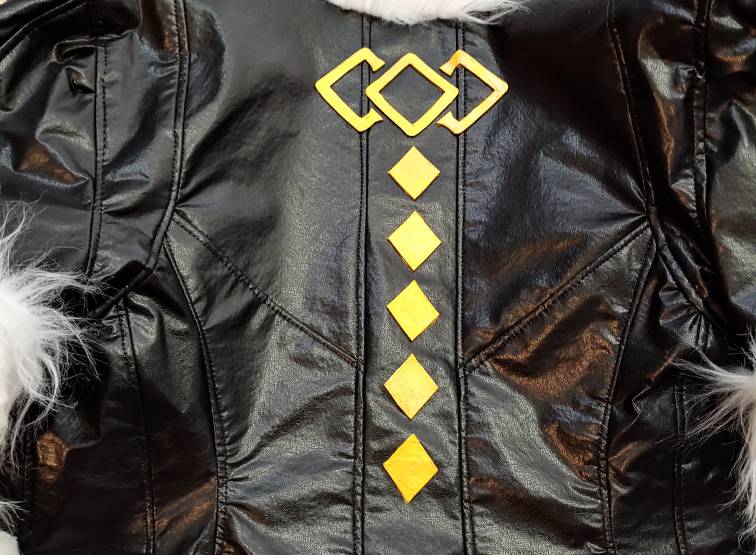
Foamies are thin sheets of EVA foam you can find at the craft store or in the craft aisle at Walmart and are often listed as foamies or craft foam. The’re about 2mm thick and are relatively flexible.
The foamies can be painted and sealed with your method of choice before gluing them down to the vinyl. As vinyl is waterproof, not all glues will work. It’s usually the most abrasive ones like superglue and contact cement that will have the best adherence with this fabric, so make sure to work in a well-ventilated area when using this type of glue!
Fasteners and closures
Now the million-dollar question: can you close it? Yes we can! Let’s talk closures
- Zipper: yes
- Velcro: yes
- Snaps: yes. Use large 1″ or 3/4″ snaps for anything that might bear weight
- Hook & eye: yes, though keep in mind the weight of the fabric.
- Eyelets: absolutely. Use canvas or boning to reinforce load-bearing laces. Decorative eyelets and laces do not need reinforcement
- Buttons: yes. Can add buttonholes too
- Belt buckle: yes. No reinforcement needed

Tablecloth vinyl has the advantage of being both a medium-weight and a stiff fabric. This gives you the advantage of not needing a lot of reinforcement when using various types of closures.
You really only need to reinforce load-bearing connections like with eyelets to ensure the vinyl doesn’t bend when you lace it up. I would also recommend reinforcing boot zippers so your boots don’t sag. Jacket zippers do not need to be reinforced.
When making belts, for the most part, you can get away with slider buckles. They have enough of a grip on the material to stay in place. If you plan on putting weight on your belt, you may want to consider a buckle with a bar and adding eyelets into your belt to make it more supportive.

I hope you enjoyed this rundown of how to work with tablecloth vinyl! It’s a versatile fabric that can make you all sorts of leather-like garments and accessories for your next cosplay (and not break your budget). You can buy it by the yard or go second-hand and buy it from the housewares section at the thrift store.
Hopefully, this rundown will get you started on your next project and you’ll have fun seeing what you too can dow ith this fabric.
@ me on social media so I can admire your work!
 Leafnin Cosplay